Series 2 for Dux ended a week and a half ago and since then I have been able to travel and clear my mind to get ready for Dux Series 3 – which should recommence in October. Dates, menu and announcements will follow within the next 3 weeks. To complete the cycle, here are a series of notes and observations from the recent dinner series for diners and general readers alike.
First the full menu with all possible pairings during this series:
Figs On A Plate
-a set of uniquely treated figs
a). Blackberry soda aperitif b). Honeyloupe melon tonic aperitif
Monet's Tomato Garden
-greek style yogurt, sage honey, tomato seed & "paint", sweet basil gelee
a). Sungold tomato 75 Pounds Gin Martini b). Yellow Doll Watermelon Miller’s Gin Martini
Summer Seascape
-smoked corn “cake”, miyagi oyster, corn milk dashi, bonito
“Mu” Daiginjo Sake
Peachtree Avenue
-peach, confit pork belly & shoulder, shortbread crumble
Dogfish Head Brewery Festina Peche Ale
Wild Mushroom Forage
-poached wild mushroom, edible dirt
a). 2009 Porcupine Ridge Syrah b).2006 Turnbull Cabernet Sauvignon
Silken Lily Pad
-house lavender tofu pudding, wildflower honey rose water and ginger syrup, “Portrait Green” (gwa look) lychee, candied ginger wet marshmallow
Russian River Brewery Pliny The Elder
S'more
-smoked mozzarella, heirloom tomato jam, tomato swiss meringue cookie, cocoa
a). North Coast Old Rasputin Imperial Stout b). Dogfish Head Brewery Theobroma
_________________________________________
“It isn’t enough to place your fingers on the piano: one must start out with a song in mind.”
-Pierre Gagnaire
This idea running through this menu was really a concept best elaborated by Pierre Gagnaire and thus paraphrased here: a dish needs to have a end result and story in mind before you can put together its parts. Therefore, the extension of the idea is expanded and applied into the form of an entire tasting menu – which means the dinner itself had to have a linear idea/story to serve as its backbone (thus Summer Landscapes). And in turn, each course should follow suit, maintain the overarching linear theme and also serve as an individual narrative of itself.
Course Notes (pics below are camera phone pics during testing phase):
Fig On A Plate:
This dish and idea was a tongue in cheek play on David Chang’s seemingly innocuous but suddenly infamous comment on the state of SF’s cooking progression. Actually the intention of the dish was part jest, but there was a reasonable intention to try to offer the first dish as both a thoroughly manipulated dish, but at the same time – one that resonated the joy of eating a fig in its most familiar summer form. The evocation for this dish was a sensation of picking a fresh fig from a tree and inserting directly into your mouth – which by texture, flavor and memory, I ‘m not sure if fig has ever been represented in a better light. However, the comments – not necessarily pointed or insulting – did spark a good deal of industry soul searching. The application of technique can be found by transforming the flavor profile of the fig by way of cold smoke and low temperature steaming.
By cold smoking in a light wood and keeping the smoke chamber temperature below 100F for over an hour, the fig was able to absorb the profile of the smoke without sacrificing its original raw structure.
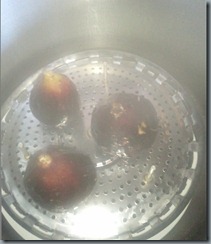
With low temp steaming (160F), we wanted to inhabit the fig with the liquid it was being steamed in. In this case, I used two types of sake throughout the 8 weeks series period. The first was a nigori sake with lavender and the second was a very toffee scented daiginjo sake. With a low temp/vapor steam, the liquid fills inside the fig, while the outer skin/texture of the fig maintains its firmness (but not its color). The steaming is typically done well ahead of time (hours or a day) because upon cooling, the fig internally builds the condensation of juices/vapor and distributes it back into its core – making for a very juicy and noticeably plumper fig than its original state.
The two modified figs were served with a unaffected common fig on a fig leaf on a plate.
Monet’s Tomato Garden
I realize that this can be one of the more pretentiously named courses, but it is derivative from the joy of seeing all the heirloom tomato varietals and colors available. A few years ago, a chef had blended a big flat of smaller heirlooms that had begun to break down. When he blended these heirloom and placed them over a china cap to strain [for tomato water], the colors of the tomato mash came to resemble the color palette for a Monet painting. Since that time, I’ve had this fascination with representing summer by way of the palette of tomato colors and variations. This dish was really a meeting point to these ideas.
The paint was a creation of pure heirloom tomato puree blended with a weighted percentage of guar gum to achieve the paint like consistency needed for plating.
Tomato seeds and surrounding gelatinous sheaths were extracted after the heirloom was blanched and peeled. It is tomato seed and its liquids that give tomato its source of much of its character and flavor – a concept that was clearly evident in other haute dishes over the last few years. Most notably El Bulli had an entire dish comprised of the seed of summer tomatoes.
Sage honey and greek yogurt served as the rich combination to absorb and draw all the flavors of heirlooms and seeds – showcasing all the sweetness, savory, and tartness of the summer tomato.
Basil gelee, made from a genovese basil extraction and gelatin ratio, was really the textural glue and binding flavor component for the dish. The accent to the dish that melded all the flavors together with its familiarity and sweetness – something that wasn’t on the first iterations of testing the dish, but a lesson learnt which derived from – oddly enough, another yogurt dish notably on the tasting menu at Benu. On that dish, the presence of pistachio turns the yogurt and other components into a transformative experience.
Summer Seaside
As a New Englander, the recollection of smelling charcoal grilled corn with the salty ocean breeze behind you is rapturous. This was the first dish conceived for Series 2 and grandfathered all the other dishes in terms of focus and philosophy. The image and recollection of the flavors for this dish are the most linear to the memories that fill it.
Dashi lent the umami requirement, the earthiness and the sea. Oysters served as the brine and crema of seafood. Corn provided the sweetness, the smokiness, the char and the balance.
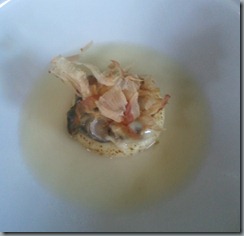
Multiple types of oysters where used to establish a proper balance throughout the dish. Unfortunately Island Creek oysters from Duxbury, MA were unavailable, but some of the others tested included Wellfleets and Kumamotos. They both represented a different end of the spectrum, Wellfleets provided an assertive brine while Kumamotos provide a strong savory creaminess. Miyagi oysters seem to maintain the best balance for the dish, so they were used.
Peachtree Avenue
Probably the most common and rustic of the dishes obviously brings the most to the table in terms of richness, simplicity, comfort and indulgence. The thought of eating a countryside peach or peach cobbler can be easily romanticized, so naturally this becomes probably the most relatable dish for a diner.
Berkshire pork belly confit in smoked duck fat and its own lard adds to the indulgence quotient. In terms of this tasting menu, this dish is the one dish that diners will likely find the least challenge conceptually, but unnoticed, happens to be one of the most time consuming in terms of preparation.
The dish is a composition of 4 split components: confit belly, bourbon plum caramel, rich (egg) short dough, and hollowed roasted halved peach.

Wild Mushroom Forage
This dish was to highlight an earthier element to the Summer, which can be attributed to the bounty of wild mushrooms available during this time. I happen to call this the most “tweezer-y” of all the dishes, this is a composed dish that is technically plated to look like a mini dirt mushroom garden. It looks exactly like what it is meant to evoke.
Edible dirt here is a streusel like consistency, flavored by my blend of spices that I call espresso mole. Call it a Bras/Adria/Redzepi tribute, but the recipe and spice blend was not derivative from any of their own. Under the dirt is a classic swash of potato puree/Robuchon – this serves as a lubricating element for the mushrooms and a physical sticking board for the mushrooms to be plated standing up.

Originally the dish did not make use of a potato puree, but because it seemed to lack moisture and a rich binder for all the flavors, it was added after the first week.
The types of mushrooms that made an appearance one week or another (because they were so seasonal) included maitake, yellow oyster, lobster, oregon black truffle, golden chanterelles, butter bolete.
All leaf and branch like mushrooms were roasted and relatively button shaped were poached in butter/olive oil blend.
Silken Lily Pad
The concept for this dish is actually derivative from Asian silken tofu. Silken tofu is typically served dim sum or after dinner with a gingered simple syrup (namely a sugar water in most places). The Summer time elements here are the floral elements and light flavors that complement them – including candied ginger and lychee.
House made tofu is set hard and pureed to a pudding texture soft. Tofu is made and infused with lavender before setting. The coating syrup is made from wildflower honey, candied ginger and rose water. Lychees complement the pudding, which to bind them a candied ginger foam (resembling and tasting like a loose wet marshmallow) is stuffed in the hollowed lychee with a small piece of candy ginger.
S’more
This is the one dish that delineates from a underlying theme of familiarity. Cautioned before serving, this dish was told to diners as the most challenging flavor-wise. Diners were simple treated with a course description of “a summer fruit interpretation,” not knowing what to expect or see. It was all happenstance that the combination of tomato jam and smoked mozzarella seemed to make sense and create an idea of a smore.
With tomato, I’ve always had an affection with creating a sweeter dessert component to showcase the versatility of the ingredient. Tomato jam is actually something that I’ve made a few times to complement toast. One time, I happened to use it against something with smoke and salt and the contrast seemed to make the jam taste somewhat chocolate-y. So the development of that idea paired with a swiss meringue cookie (designed to look like the top of a french macaron) seemed to evoke the flavor of a smore.
The hardest part of the dish was really the proportion between tomato jam, cheese and sugar content of the meringue. Seeing as to how there was no control over the sugar content of a meringue, I did many tests with the thickness, brulee and size of the smoked mozzarella. The proportion of tomato jam also took a bit of time. The first few experimentations seemed almost disastrous and having been lost (palette-wise during testing) in multiple tested ratios, I wasn’t confident in the reception even when I thought the balance of the dish was good.
The reception to the dish was the most surprising because diners seem to immediately understand the connective flavors between a ideal smore and the conceptual one in front of them. They also appreciated the deviations of textures and complexity with this result as supposed to a classic smore. It was quite possibly the most unanimously intriguing/loved dish amongst all of the others. It was a pleasant and unexpected result because I think I would have been satisfied with love-hate.


